
Alpaca wool: soft warmth you can believe in

High in the mountains of Peru and Bolivia, where the air is thin and the sky seems closer than usual, alpacas live. Quiet and gentle, with large dark eyes that seem to reflect the evening. They roam the slopes of the Andes in small herds, graze on grass, warm themselves in the sun, and carry on their backs the wool people have cherished since long before there were cities, paper, or even alphabets.
Alpaca wool is something special. Textile guides are written about it, scientific papers are dedicated to it, and it is often compared to cashmere and praised above sheep's wool. But if you leave the dry science aside and simply touch it, you understand immediately: this isn't just wool. It's something closer to a cloud. To a warm breath. To the feeling you get when you wrap yourself in a blanket on a cold evening and the whole world suddenly feels softer.
Where does it come from?
Alpacas are sheared once a year — usually in spring, when the Andes begin to warm up. One animal produces between two and four kilograms of wool. That's not much: by comparison, a sheep produces an average of five to seven kilograms at a time. But alpaca wool is more valuable precisely because there is less of it, and because every single fiber is special.
If you look at an alpaca fiber under a microscope, you can see that it is hollow inside. A tiny tube filled with air. That air is what makes the wool so warm — it keeps the cold out and retains body heat. Sheep's wool fibers are denser, without the same hollow core, which makes sheep's wool heavier and less insulating than alpaca wool of the same weight. Studies suggest that alpaca wool can provide significantly more warmth than sheep's wool for the same weight.
Why doesn't it itch?
Many people know the unpleasant feeling: you put on a wool sweater and your skin starts to itch. Sheep's wool contains lanolin, a natural fatty substance produced by sheep, which can irritate sensitive skin.
Alpaca wool contains very little lanolin. That's one of the reasons it is often considered hypoallergenic and can feel gentler than traditional sheep's wool. Alpaca fibers are also naturally fine and soft, with premium fibers measuring around 18–25 microns in diameter.
What feels soft to the touch feels soft to the heart, too.
Where do all those colors come from?
Nature has given alpacas a remarkable range of natural wool shades — from pure white through different tones of beige, brown, reddish and gray, all the way to almost black. This natural palette makes it possible to create beautiful pieces by combining naturally occurring shades rather than relying entirely on chemical dyes.
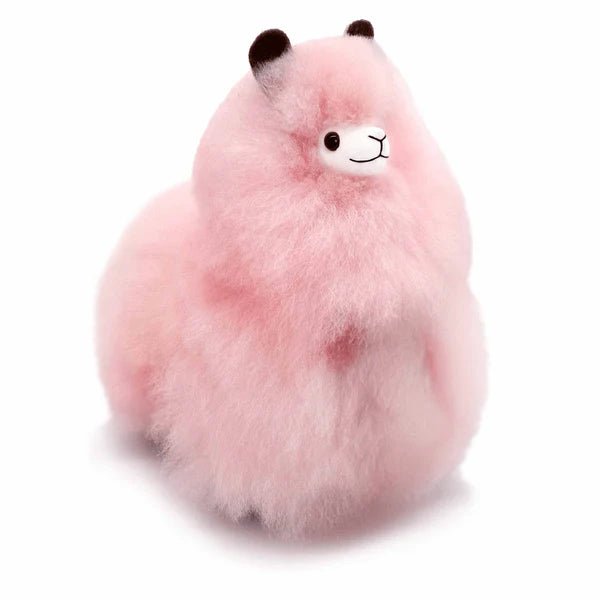
When we created our Fluffy alpacas, we wanted to preserve exactly that feeling — that color comes from within, softly and naturally. That's why even the brightest ones — Rainbow Alpaca and Alpaca Monster — remain fluffy, like clouds at sunset. Not glossy, not flat, not artificial. Warm.
A quick look at alpaca wool
- Natural fiber from alpacas native to the Andes
- Provides excellent warmth for its weight
- Contains very little lanolin and is gentle to the touch
- Fine fibers, typically around 18–25 microns in premium alpaca wool
- Comes naturally in a wide range of shades
- Alpacas are generally shorn once a year in spring, without harming the animal
Why choose it for children's toys?
When a child picks up a toy, they don't evaluate it by its description. They feel it. With their skin, their cheek, their nose — all at once. And if the wool is scratchy, if the smell feels strange, if the weight isn't right, the toy will stay on the shelf. But if it feels soft, warm and just right — it becomes a friend.
Alpaca wool creates that feeling of “just right” from the very first touch. It doesn't feel like synthetic fabric, and it doesn't have the scratchy sensation associated with some traditional wool. It is simply warm and soft. And sometimes that's all it takes for a little hand to find its place in that softness and not want to let go.
We chose alpaca wool not because it's fashionable or expensive. We chose it because we tried different materials and realized that nothing else creates quite the same feeling. When you hug an alpaca made with genuine wool, it feels a little like hugging a piece of the Andes themselves — their warm breath, their evening sun, their quiet calm.
And perhaps that's what we want to give children. Not just a toy. But a little piece of a world where everything feels soft.
feel the softness for yourself
Explore all alpacasFrequently asked questions
Is alpaca wool really hypoallergenic?
Alpaca wool contains very little lanolin, which is one reason it is often considered gentler than traditional sheep's wool. However, individual reactions are possible with any natural fiber, so if a child has a severe allergy, it is best to start with brief, supervised contact.
How is alpaca wool different from regular plush?
Regular plush is usually made from synthetic fibers such as polyester. Alpaca wool is a natural fiber that is warm, breathable and soft to the touch. It has a distinctive natural texture and does not feel like ordinary synthetic plush.
Does shearing an alpaca hurt?
No. Alpacas are generally shorn once a year using specialized shearing equipment, much like sheep. When done properly, shearing does not hurt the animal. In warmer weather, removing the heavy fleece can actually make the alpaca more comfortable.
Is the alpaca wool in Fluffy toys real?
The outer layer of our alpacas is made with natural alpaca wool, which creates that soft, warm feeling. Inside is a soft filling designed to help the toy keep its shape. Our materials are selected for use in children's products.
How long does a plush alpaca last?
With proper care, for many years. Alpaca wool is durable, and the filling is designed to retain its shape. Many of our customers tell us that their alpacas remain beloved companions for years as children grow up.
with warmth —
the Fluffy team


