
Alpacas for Little Ones — What Age Are They Suitable For and Why It Matters

When a little one joins the family, the world around you becomes quieter and more careful. You walk around the house on tiptoe. You check the water temperature with your elbow. You look at labels more closely than ever before — where it was made, what it is made of, who made it. And the first things a child touches with their tiny fingers are chosen with particular care. Because those first touches help shape their trust in the world.
So when you choose an alpaca for a very young child — for a godchild, a newborn, or your first baby — questions like “is it safe?”, “is it hypoallergenic?”, and “what age is it suitable for?” are not formalities. They are the whole point. We'll tell you everything we know ourselves.
What the Safety Standards Say
In Europe and Ukraine, there is a general safety standard — EN 71. It is a set of rules that children's toys must meet. It covers everything: which materials can be used, what kind of glue is permitted, how strong the seams must be, how eyes should be attached, and the acceptable noise level for musical toys.
The strictest requirements apply to toys intended for children under three years old. Such a toy must not contain any small parts that a child could pull off and swallow. Seams must withstand a certain amount of force. Paints must be non-toxic. The standard is strict and appropriate, and we make our alpacas with it in mind.
But there is still a difference between “complies with EN 71” and “suitable for a two-year-old.” And here is our advice: for very young children — under three — it is better to wait until they are a little older, or place the alpaca near the crib as a room decoration, without direct contact. Our alpacas have small elements (bead eyes), and although they are securely sewn on, we honestly state that the recommended age is 3+.
Why Alpaca Wool Is a Gentle Choice for Little Ones
A newborn's skin is much more delicate than an adult's. Any roughness can cause irritation. Any synthetic material that builds up static electricity can be uncomfortable. Any strong smell can be overwhelming.
Alpaca wool is, in this sense, an exceptionally gentle material. It contains no lanolin, which sensitive skin can sometimes react to. It does not easily build up static electricity. It has no strong artificial smell — after shearing, the wool is simply washed without harsh chemicals. In terms of softness, it sits somewhere between cashmere and silk.
What's Inside the Alpaca
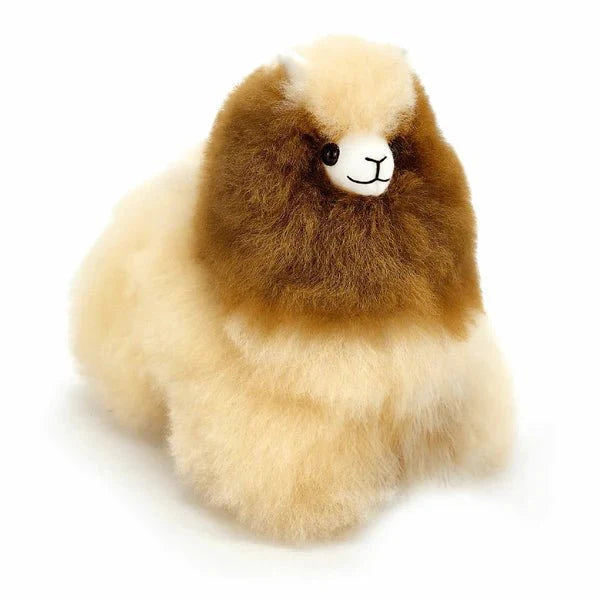
On the outside, our alpacas are covered with genuine alpaca wool. Inside, there is hypoallergenic polyester filling. It may sound unusual that the filling is not natural, but we chose it for a reason: it holds its shape, does not clump over time, does not absorb moisture or encourage mold, and can be safely washed. Natural fillings — down, cotton, or wool — can become compacted over time and may provide an environment for dust mites. Polyester filling does not have this issue.
It is a compromise that many quality children's toy manufacturers make, and we do too. On the outside — softness that melts your heart. On the inside — safety you can rely on.
Safety at a Glance
- Alpaca wool is hypoallergenic and contains no lanolin
- The filling is polyester fiber, safe for children
- All materials comply with the European EN 71 standard
- The recommended age for all Fluffy alpacas is 3+
- The toy does not easily build up static electricity, has no chemical smell, and does not fade
- It can be washed and keeps its appearance for years
When to Give an Alpaca
We have seen alpacas given for christenings, maternity hospital visits, and first birthdays. We have seen three-month-old babies who cannot hold one yet, while their mothers place the alpaca beside the crib and say: “This is your friend. It will grow up with you.” And the alpaca does grow alongside the child — year after year, setting new records for how far it travels: from the shelf above the bed to kindergarten, school, university, and their first apartment.
If you are choosing an alpaca for a very young child, choose a Large Alpaca and place it in the child's room as a new member of the family. Not “in the crib,” not “to play with,” but simply to be there. So that the first thing the little one sees in the morning is something soft, warm, and comforting.
A little person doesn't need much: warmth, their mother's voice, and a big friend nearby.
What We Tell Grandparents Ourselves
When grandmothers write to us — and they write often — we tell them: don't be afraid to go big. Your grandchild is three months old? Choose the Large 50 cm. They may not play with it yet, but a year from now they will stand next to the alpaca, and it will be just the right height for them. Another year later, they will be talking to it. And two years after that, taking it out for walks.
An alpaca is a toy with a long life. You buy it today, but its full meaning unfolds over a year, two years, five years. Because it is not the kind of toy that is played with for a month and then forgotten. It quietly lives alongside you and gradually becomes part of the family.
for the little ones — go big
Discover Large AlpacasFrequently Asked Questions
Can I place an alpaca near a newborn?
Nearby — yes, as a room decoration or a cozy element. In the crib with a sleeping baby under one year old — no, just like any other toy. Pediatric sleep-safety recommendations advise keeping the crib clear during the first year. Let the alpaca stand nearby, on a shelf or in an armchair, and wait for its time.
What if my child has allergies?
Alpaca wool is hypoallergenic, but that does not mean there is absolutely no chance of a reaction. If your child has a severe allergy — to wool products, dust, or fabrics — we recommend starting with brief contact under supervision. Most children tolerate alpaca very well, but individual reactions cannot be completely ruled out.
What age can a child start playing with an alpaca?
We recommend alpacas from the age of three for all sizes. Before three, an alpaca can be kept in the child's room as a decoration, but for direct play it is better to wait — this is a general safety recommendation for toys with small elements.
How do I wash an alpaca?
The best option is to wash it by hand in warm water with a gentle children's detergent. Do not wring it hard; let the water drain and dry it flat on a towel, away from radiators. Machine washing is possible on a delicate cycle at up to 30°C, but we do not recommend it.
What if the alpaca gets food or paint on it?
It is best to treat a local stain immediately: use a damp cloth with gentle children's soap and carefully work from the edge toward the center. Pat dry with a towel. In most cases, the stain can be removed without washing the entire toy.
How many years does an alpaca last?
With normal care, for decades. Alpaca wool retains its appearance remarkably well, and the filling does not easily become lumpy. We regularly receive photos from our customers: “Masha is twelve now, and her alpaca has been with her since she was three. It is still her favorite.”
with warmth —
the Fluffy team


